Showing posts with label Tony Hays. Show all posts

Saturday, May 21, 2011

Review: The Divine Sacrifice by Tony Hays


★★★
Source: I received a copy in exchange for a fair & honest review
Release Date: April 2010

Book Synopsis: "Malgwyn Ap Cuneglas is a trusted counselor to King Arthur, right-hand lieutenant to the warrior chief. Right hand, that is, until a Saxon cut off his sword arm and left him to die on the battlefield. Arthur chose to go to extraordinary lengths to keep the man alive as he valued Malgwyn as much for his brains as his sword arm. Malgwyn hated Arthur for this dubious gift but has come to grudgingly acknowledge that he yet may have some purpose in life." "That purpose is put to a test when Arthur and Malgwyn travel to Glastonbury Abbey to investigate reports of rebellion. The abbot, while cordial, is guarded. They chalk up his demeanor to the sudden arrival of Saint Patrick, a legend in the Church, who has come to the abbey on a mission of his own, to root out the heresy of Pelagius. 

All hell breaks loose when an aged monk is found cruelly murdered in his cell, and Malgwyn is charged by Arthur to not only discover the culprit but to determine if the monk's death fits in with the disturbing rumors of disgruntled lords banding together to overtake Arthur's throne." Malgwyn discovers a maze of half-truths and lies that lead him to a conspiracy to topple the Church ... and his lord's kingdom.

My Review: After reading the first novel in this Arthurian mystery I could not wait to start the second novel in the series. I thought the adventures could only get better from here, sadly that wasn’t the case. 

The book had a very slow start and instead of the storyline taking place in the Castellum Artorius, which is the name of the location of Arthur’s castle, the storyline was centered around Yins-witrin the Christian community that is now known as Glastonbury. Yes, all the same characters were present in this second novel plus a few new characters; however, they all took a back seat this time to Malgwyn ap Cuneglass, Arthurs most trusted lieutenant. I would have liked to have seen more of Merlin, Arthur, and Guinevere in this novel. 

Like I mentioned before, the story got off to a very slow start, which almost made me give up and put the book down but I kept pushing through it. This is probably why it took me twice as long to finish as I normally would have taken to finish a 300 page novel. Once the plot finally took off my interest would be captured for a bit then it would tapper off and then it would take off again. This is what I like to call a “rollercoaster thriller”. It had its many ups and downs and then it takes you up to that very steep incline then you plunge to your “death.” That is exactly how I would describe Tony’s second novel. Unlike, the first novel in this series “The Killing Way,” I didn’t think the twists and turns were nearly as good as the first novel. I was really disappointed. I was expecting this big twist in the very end; although, there was one but it wasn't as mind blowing as I was anticipating. 

Overall, this was just okay in my opinion. It wasn’t an utter failure for a second novel in a series but there was a lot of room for improvement. If you read the first novel in the series “The Killing Way” and loved it as much as I did then I would only recommend reading this one in order to get you to the final novel in the series “The Beloved Dead” because I heard it was just as good as “The Killing Way.” If you don’t plan on continuing the series then I would not recommend reading this one.

Friday, April 15, 2011

Review: The Killing Way by Tony Hays


★★★★
Book Source: I received a copy in exchange for a fair and honest review.
Release Date: 2009

Book Synopsis: It is the time of Arthur, but this is not his storied epic. Arthur is a young and powerful warrior who some would say stands on the brink of legend. Britain’s leaders have come to elect a new supreme king, and Arthur is favored. But when a young woman is brutally murdered and the blame is placed at Merlin’s feet, Arthur’s reputation is at stake and his enemies are poised to strike. Arthur turns to Malgwyn ap Cuneglas, a man whose knowledge of battle and keen insight into how the human mind works has helped Arthur come to the brink of kingship.

Malgwyn is also the man who hates Arthur most in the world. After the death of Malgwyn's wife by Saxon hands, he became Mad Malgwyn, killer of Saxons and right-hand lieutenant to the warrior Arthur. Right hand, that is, until a Saxon cut his sword arm off and left him to die on the battlefield. Arthur rescued him. Now a one-armed scribe and a heavy drinker, Malgwyn rejects the half-life that his liege gave him. But loyalty is sometimes stronger than loathing and Malgwyn is pulled toward a puzzle that he can’t walk away from.

Review: The legend of King Arthur has always fascinated me so when I was asked to review an entire series based on a murder/mystery set during the time of King Arthur, I jumped at the opportunity!
This isn’t your typical King Arthur, knights at the round table sort of book. Instead, it’s a murder/mystery that takes place right in the middle of Arthur’s city just before the election for the new Rigotomas “High King” takes place. All the noble lords from surrounding lands have traveled to Arthur’s city for this important election where Arthur is the top candidate. Just before the election can get under way, a young serving girl by the name of Eleonore is brutally murdered and her body is left at Merlin’s door making him the prime suspect. 

As the investigation gets underway, Malgwyn, who is chosen by Arthur to solve this mystery, discovers there is more to Eleonore’s murder than meets the eye and when another woman turns up murdered he really knew something big was at stake. As some of the pieces began to fit together, he realizes both women were murdered because they overheard a plot being discussed that would somehow hurt Arthur’s reputation and chances to be elected as the new Rigotomas. Despite Malgwyn’s personal dislike for Arthur, he knew he was a good man and leader who did not deserve to be brought down like this. 

This is a gripping tale that grabs you by the arms and doesn’t let go until you reach the end. I loved all the characters, especially Malgwyn who comes off as a mean old drunk who doesn’t care whether he lives or dies, but you soon realize that he’s just big ole bear with a kind heart. He knows if he fails he won’t have a lot to lose but he knows if he does Arthur’s position and life could be at risk. 

I loved this book, probably more than what I thought I would! It moves at a very fast pace and it’s an easy read that keeps you guessing all the way through. Who doesn’t like a mysterious murder that takes place during the time of the legendary King Arthur? This is a highly recommended read and I can’t wait to read the next book in this series The Divine Sacrifice.

Tuesday, April 12, 2011

The Legend of King Arthur Fact or Fiction?


While reading Tony Hays’ novel The Killing Way, which is based on a murder mystery set back in Arthurian times, I became curious as to how much of the legend of King Arthur is true or if it is just a mythical adventure that has inspired books, cinemas, and even plays.

Here in this post I’m going to explore who King Arthur really was, where Camelot would have resided and in the end I hope I will be able to shed some light on what is fact and what is fiction. 

The Legend Behind the King

If not all, most of us are pretty familiar with the legend of King Arthur, his code of chivalry, quest for the Holy Grail, betrayal by his wife (Guinevere) and best friend (Lancelot), etc… If you are not so familiar with the Arthurian legend here is a link that will briefly sum it up for you. 
Historians have dated the story of King Arthur back to the end of the 5th century to the beginning of the 6th century A.D., which is known as the Dark Ages. It was called the Dark Ages because so little is known during this time period and it was during a time of strife and chaos.
The Legendary Arthur
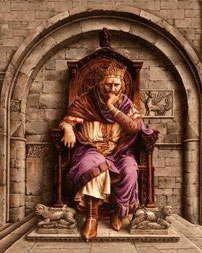
A 19th-century painting by Frank Dicksee
depicts a medieval monarch in golden armor. 
This is the traditional image we have come
to associate with King Arthur.

During this time, the Briton’s were enjoying peace and prosperity that came from their status with the Romans; however, the Roman Empire was on the verge of collapse causing the Roman armies to leave Britain to fend for themselves. This was not good for the Briton’s because the Roman army had been keeping the country in order since the 1st century, which provided them with efficient roads, trade, and most of all protection from foreign invaders. Once the Romans left, it paved the way for invaders such as the Irish who came by sea and took over the western coast of Britain and also the Scots and Picts (the painted people) to come by land from the north. 
The Historical Arthur
Illustration by military expert Dan Shadrake
showing Arthur in genuine Roman-style armor of the
fifth century.  If Arthur was an historical figure
then this is how he would have looked.

So the Briton’s decided to bring in Germanic mercenaries (Angles and Saxons), which turned out to be catastrophic because the Saxons grew greedy and decided to turn on the Briton’s causing a full fledged war. This is when the Briton’s needed a hero to rise up and save them. Soon the Saxon invasion ceased causing many people to believe there was some mysterious war leader responsible for saving them. So this is where the legend of King Arthur begins.    
 
Was King Arthur A Real Person or a Character Based on Folklore? 

This is a difficult question to answer because there is virtually no hard evidence that he ever existed. Some historians say yes that he could have been based on a certain historical figure during the Dark Ages or he could have been based on a composite of many heroic warriors during that time. Others say yes due to the gap in the records during that era, which could have been easily filled with Arthur there. Then other historians claim that since no reliable evidence has ever been found, then we should not assume he was truly a real person. The harshest view I found on Arthur’s existence was by David Dumville - "Histories and Pseudo-histories" (1990) he stated, "The fact is that there is no historical evidence about Arthur; we must reject him from our histories and, above all, from the titles of our books." So as you can see the facts and the fantasy repel one another. 

Who Was the Real King Arthur?

So if the legends are true and Arthur was real then the million dollar question we like to ask ourselves is who was he? There are many theories as to who King Arthur really was. As I mentioned before, he could have been some fearless war hero who has been fluffed up by folklore or he could have been multiple figures compiled into one legendary being. As I researched this topic I narrowed down the top three candidates that many historians believe could have been the man behind the myth.
Ambrosius Aurelianus

One of the candidates some historians believe to be the real Arthur is, Ambrosius Aurelianus, who was thought to have been a supreme Roman commander of Britain during the late 5th Century AD. He is a contender because he lived during the same time believed to have been the time of King Arthur’s reign. He also could have changed his name to Artorius and eventually become known as Arthur. Another key factor is that Ambrosius was thought have been a Roman commander and many believe King Arthur was part Briton and part Roman.

The fact that Ambrosius fought and won an important battle against the Saxons and was the nephew of Uther Pendragon according to Geoffrey of Monmouth’s Historia Regum Britanniae, makes him a top contender. However, some historians are refuting this possibility because he would have been at least seventy years old when the Battle of Badon Hill took place. The Battle of Badon Hill was King Arthur’s greatest triumph over the Saxons. During this era, the typical life span was around thirty-five making it difficult to believe Ambrosius lived to the age of seventy, let alone fought and won a prestigious battle.

Lucius Artorius Castus
This is the theory the film
King Arthur was based on
played by Clive Owen

A second possibility also coincides with the Ambrosius Aurelianus theory. Some historians like to believe that Ambrosius’ story was somehow intertwined with another Roman officer called Lucius Artorius Castus. Artorius is the Latin name for Arthur. Lucius Artorius Castus was a Roman officer alleged to be stationed in Britain during the 2nd century AD. However, if you have been paying close attention you would have immediately noticed a rather significant problem with this theory. According to Nennius, a Welsh monk who wrote History Brittonum, “A History of Britain,” somewhere between the 7th and 9th century, Arthur lived during the late 5th century making Artorius Castus a highly unlikely candidate for King Arthur. On the other hand, some historians are hesitant to contest Artorius as the legendary Arthur and here’s why.

Over the centuries, historians, scholars, and some archeologists have noticed that there are quite a few similarities that could connect Artorius to Arthur. For instance, Artorius Castus was associated with a cavalry unit of Sarmatian soldiers, who fought the Saxons and flew a pendragon banner at the head of their units as they rode into battle. It has been recorded that the Sarmation soldiers were known to have worn scale armor and to fight with long swords, which made them look like medieval knights even though that was way before their time. Another similarity between the Arthurian legend and Lucius Artorius was that the Sarmation people worshiped a sword in the ground during some religious rights and Sarmation legend talks of a Sarmation warrior who wielded an unstoppable sword, which sounds a lot like Excalibur. So despite the inconvenient four hundred year gap between Arthurian time and the time of Lucius Artorius Castus, Castus would have been a perfect fit for the man behind the legendary King Arthur.
Riothamus

Probably the most believable and more accepted of the candidates is the high king Riothamus, who reigned over the British and Breton people from what has been suggested to be between 454 and 470 AD. The man behind this theory is Geoffrey Ashe author of The Discovery of King Arthur

What we know about Riothamus is that he was real and was King of Britain sometime in the middle of the 5th century AD., which fits the same time frame depicted to be when King Arthur flourished. We also know that he was a true warrior who led his soldiers into battle against the Saxons. He was highly respected and viewed as a true leader among his people all of which fit the criteria of King Arthur. Probably the most esteemed similarities between the two is the fact that Riothamus was only his title, which translates into “Supreme Leader” in English. His Christian name was Artorius and after their battles, both Arthur and Riothamus travelled to Burgundy and then to Avalon. Even though the legend says that the Isle of Avalon was a magical land surrounded by water, the Avalon that Riothamus journeyed to was what is now known as modern day Glastonbury in the United Kingdom. Even though it may seem like a stretch to believe Riothamus was the man behind the legend he appears to be the closest thing to King Arthur and it is easier to accept the fact that there was only one Arthur and not two or more historical figures competing to form the basis behind the legend.


South Cadbury "Camelot"


The Real Camelot

How can I discuss King Arthur without even mentioning his enchanting castle in his city Camelot, or was it really a castle? 

Glastonbury "Isle of Avalon"
Many historians and archeologists alike, believe that the most probable location of the city of Camelot is South Cadbury in the United Kingdom. However, it most likely was not the enchanted city legend claims it to have once been. It was almost certainly an equipped town made of wood rather than a stone castle or fort. We did not see stone castles until the time of William the Conqueror during the Medieval era. Also, Arthur probably would not have called his city by Camelot because the name “Camelot” is most likely French and originates from the 12 century.

Historians and archeologists believe South Cadbury to once have been the Arthurian city of Camelot because it is so close to where the battle of Badon Hill was fought and it is literally only 11 miles away from Glastonbury, which is thought to be the modern day Isle of Avalon. Doubtless the biggest kicker is that a grave has been discovered there, which contained men and boys, unmistakably fallen in battle. So some believe it was a grave of those who fell during the battle of Camlann, Arthur’s last battle which may have been fought to defend the city from the Saxons.

 I had the pleasure of having Tony Hays, the author of an Arthurian mystery series; on my blog where he discussed in immense detail his journey to Camelot, “Cadbury Castle,” in order to further research King Arthur for the newest book in his series, The Beloved Dead. Here is the link to his post if you are interested in reading his rediscovery of Camelot.

What is Fact and what is Fiction?

Unfortunately, due to the lack of evidence we may never know what was fact and what was fiction concerning the legendary tale of King Arthur. There are so many legends and myths surrounding Arthur that has touched us all at some point in our lives. I know I fantasized about King Arthur, Guinevere, and Lancelot as a little girl ever since I watched A Kid in King Arthur’s Court and First Knight. He may just have been a hero created from folklore or he could have been a real. In my opinion he was real, whether he was just one person or a combination of many I don’t have the answer, but I sure hope someone will be able to unveil Arthur for what he truly was: a fierce warrior and a true leader.
           

Friday, March 25, 2011

Guest post: Tony Hays' Journey in Discovering What May Have Been the True Camelot


I'm so excited to have Tony Hays on All Things Historical Fiction. He is the author of an Arthurian series and is here today to discuss how he was able to capture Camelot as it may have looked for his newest book, The Beloved Dead. Stay tuned next month for my review of his first novel in his Arthurian series, The Killing Way. So lets get to the guest post!


 Tony Hays author of The Beloved Dead
Tony's Journey in Discovering What May Have Been the True Camelot
Sometimes, you paint yourself into a corner that is really, really difficult to deal with.   But I had no real choice.  I had boxed myself in to a 16 mile hike across southwest England, from South Cadbury to Glastonbury, as the crow flies as much as possible.

I had driven the route many times, knew it by heart.  Plus, I had hoofed up and down and all over South Cadbury Hillfort and Glastonbury, the primary settings for my new Arthurian mystery series, starting with The Killing Way and followed by The Divine Sacrifice.  

But my earlier research trips had been relatively short, a week or two at the most.  This time, I had moved to England for six months, leasing an efficiency flat in the little village of Butleigh, about five miles to the south by southeast of Glastonbury.  So, time was not a real consideration as it had been before.  And I wanted The Beloved Dead, the third in my Arthurian series, to be the biggest and best yet, in every way.  For me, that meant walking the ground as my characters had, smelling the smells and climbing the hills.
Arthur & Guinevere Sign

While archaeologists and historians are split on whether Arthur was real or not, they are unanimous in saying that the hillfort at South Cadbury underwent a massive renovation and rebuilding project at just the time that Arthur would have lived by someone who had Arthurian-sized resources at his command.   And as early as 1541, local folklore had made this hill Arthur’s headquarters.   It was a natural for my mid 5th century world of mud, wooden huts, foul smells and raiding Saxons.


Glastonbury was a given.  The earliest traditions made the “Mother Church” at Glastonbury Abbey perhaps the earliest Christian site in England.  The alleged 1191 exhumation of Arthur and Guinevere by the monks at Glastonbury just put the proverbial icing on the cake, not to mention the assertion that on the infamous lead cross buried with our lovers was a claim that Guinevere was Arthur’s second wife.  Then there was that pesky early story of a king of the “Summer Country” named Melwas, who kidnapped Guinevere.  No, drive-by research wasn’t going to cut it this time around.  So much of the novel’s action took place between South Cadbury and Glastonbury that I was going to have to apply shoe-leather to pavement, so to speak.

Across the Levels from Copley Wood 

So, one fine July day, I put on my special Dark Ages shoes (a pair of high top sneakers that really have little sole to them so it’s like walking in a moccasin or having your feet wrapped in leather), strung  my pouch from my shoulder and started out from the hillfort, headed to the abbey.  My goals were twofold – find out how long it would take to walk from South Cadbury to the abbey, and get a sense of what that journey would entail in physical exertion etc.

Copley Wood

From the summit of the hillfort, Glastonbury Tor can be seen in the distance, across the southern reaches of the Somerset Levels, rising like a pointing finger into the sky.  Up there the route looks fairly straightforward,  but in reality the path is a little more circuitous than it would appear.  The British love their walking paths, and I stuck to those as much as possible.   Headed in a generally northwest direction, I had certain places I wanted to include – Copley Wood, Compton-Dundon Hillfort, the Polden Ridge.

So, I started along the Leland Trail, a series of footpaths associated with the great tour of John Leland,  Henry VIII’s antiquary.  That took me generally along the A303, to West Camel.  From there, I turned north and took Steart Lane up to Charlton Mackrell and Charlton Adam.  This much of the journey was fairly uneventful.  I had kept a brisk pace, as I suspected that people in my time period would do.

 Compton Dundon Hillfort

But then came the fun.  I switched onto a road that eventually became known as Reynald’s Way, that ran up and along the Polden Ridge, and across a bank and ditch known as the New Ditch that may date to the Iron Age, but also was probably in use in the Dark Ages as well.  What you have to understand about the Levels is that back in the Dark Ages, a good hard rain could flood the levels so that Glastonbury, Compton-Dundon Fort, and the Polden Ridge were almost  islands that rose above the flood waters.   And the Polden Ridge would have been if not the safest, at the least the driest route to Glastonbury.   I’ve often believed that New Ditch had a defensive purpose in the days of Arthur.  

By the time that I had reached the spine of the ridge, I was out of breath and wondering why I demanded so much accuracy of myself.  I mean really; could anyone in the 21st century actually learn anything about life in the 5th century by hiking 16 miles?  My pounding heart said no, echoed by my blistering feet.  They were, if anything, a hardier people.  But then I turned down into Copley Wood, to catch a glimpse of the Compton-Dundon Hillfort.  And suddenly, I was back in the 5th century, hiking along forest trails with my protagonist, Malgwyn.

It took little effort to imagine what travel would have been like back in those days.  Other than the Fosse Way, the closest Roman road, travellers would have been forced onto dirt lanes like these.   Narrow, dark, barely wide enough for a single wagon and ox.   I twisted my ankle twice picking my way down trail.  I breathed deeply of the air.

As I emerged from the tree line, I saw the hillfort, smaller than Cadbury Castle, but impressive nonetheless.  I felt stronger then, and I determined to complete my quest by hiking down through the village and up onto the hillfort plateau.  I had a special reason for wanting to see that fort, but that is a surprise that you’ll have to read The Beloved Dead to discover.  Let’s just say that I found it the perfect setting for what I had in mind.

The sun had travelled well past meridian height by the time that I made it back up to Reynald’s Way.   I picked up the pace, pausing only long enough to note the location of New Ditch.  Yes, it would have been an excellent place for a defensive barrier.  The land dropped off on either side, making this an effective bottle neck.

Continuing on down the road as it began to slope down towards the B3151 heading into what is now Street, England, but back then was probably just forest, perhaps a farmstead or two.   I stopped before I reached Pomparles Bridge, that place where Bedevere launched the mortally wounded Arthur off in a boat for the Isle of Avalon.   Turning left, I followed a side street until I found the parish church, a place believed so anciently divine that it once held a Roman shrine before a small chapel, known as Lantokay or Kay’s Chapel, was built from its ruins.

I timed how long it took me to get there and back to the main road, and how long it took me to make it to Pomparles.  Breathing, feet, all were forgotten by then.  

 Glastonbury Tor from Cadbury Castle

I was there.  Where my book would happen.   And, whether because of exhaustion or a too active imagination, I was when it was as well.  The cars were gone.  The houses too.  I could see how Glastonbury and its famous Tor would look like an island when the waters were high.  I could see the fortress of the Dark Ages lord thought to have been atop the Tor.  And as I tramped across the bridge, I was walking on wood and stone and then along a muddy trackway at the foot of Wearyall Hill.  Then , I was in the Abbey grounds, looking at where the “Mother Church” had stood.    Night was about to fall, and in the darkness I thought I could see the lamps in the monks’ huts, their dark, robed, huddled forms scurrying about the ground.
I could write the book then.   I had been there.  I had seen it.
 Storm Clouds Over Camelot

To celebrate, I took a taxi back to my flat in Butleigh.  The journey was finished, but the magic was still in my head.  I dove into the book in earnest, and wrote as quickly and as well as I ever have.  All because of a single research trip.  

And several blisters.